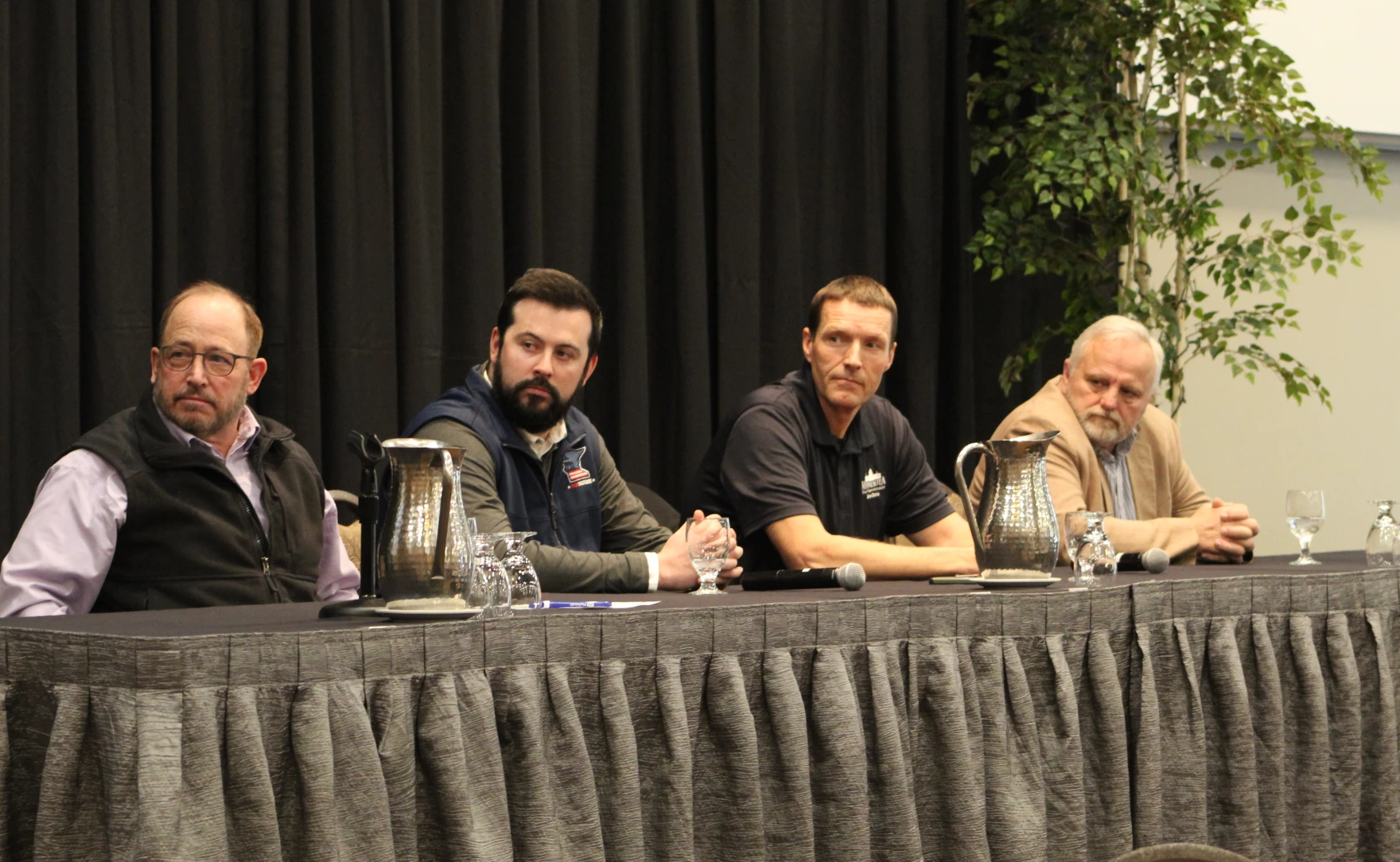
Count New Ulm’s mayor among the numerous city leaders who want Minnesota lawmakers to pass a bonding bill this year.
After all, significant state funding is necessary to get local projects done, said Kathleen Backer during a Coalition of Greater Minnesota Cities press conference. Replacing lead pipes, and really any clean or waste water project, simply wouldn’t be possible without the aid.
“This is not a situation where this is a want,” Backer said. “This is a need, a very basic need.”
As opposed to the state’s budget, needs never run dry during legislative sessions. Local government units are requesting a combined $3.19 billion in funding from the state this year, while even a top-end scenario for a bonding bill’s success would tap it out closer to $1 billion.
A worst-case scenario, on the other hand, would be nothing getting passed. What are the chances of that happening? Legislative leaders are starting out optimistic, but they foresee plenty of hurdles springing up during the session.
Bonding bills start with hope
Hope springs eternal for Sen. Sandra Pappas, DFL-St. Paul, ahead of the session, which begins Feb. 17. The chair of the Senate’s Capital Investment Committee said she tends to be optimistic, feeling like her good working relationship with the committee’s Republicans will set a positive tone.
Last year, once lawmakers passed a $700 million bonding bill, Pappas’ understanding was that more direct funding for local government projects will be a priority in 2026. She still expects this to be true.
The strategy should appeal to rural Minnesotans, who are predominately represented by Republicans, she said. Their communities typically benefit greatly from bonding bills.
Related: Greater Minnesota water projects will flow from Legislature’s bonding bill
“Bonding bills are heavily slanted toward rural Minnesota,” she said. “That’s where a lot of our colleges and universities are. That’s where our parks are. I really think it’s an advantage for rural Minnesota that we do a bonding bill every year.”
Why? Because bonding bills authorize the state to borrow money through the use of general obligation bonds. A city, county or other government entity might otherwise need to go it alone borrowing money, and then be expected to foot more of the bill when the debt repayment comes due.
Direct funding is one way local governments get bonding bill dollars. Lawmakers agree to include what is essentially an earmark in a bonding bill; the project gets funded.
To use New Ulm, a southern Minnesota city with a strong German heritage, as an example, the city wants about $2 million for a sewer and water main replacement project. It could get it directly in a bonding bill, or through another pathway largely utilized in last year’s bonding bill.
The second path steers funding through state agencies to local projects. Lawmakers put bonding dollars into the agencies. In turn, agencies distribute funds based on something of a grading system.
Akin to Pappas, Sen. Karin Housley, R-Stillwater, is hopeful heading into the session. She feels her Republican Senate caucus will want to work across the aisle to get things done.
“We all know the needs, so we are hoping it can all come together,” said Housley, the ranking minority member on the Senate Capital Investment Committee. “But you never know how the session will go.”
Senate Minority Leader Mark Johnson, R-East Grand Forks, named bonding among his top priorities for the legislative session. It could be a step toward his wish for bipartisan solutions.
As to which projects will make it, he said “we each have projects in our district we particularly like.”
He added that the scope of the bonding bill will be dependent on Minnesota Management and Budget’s economic outlook set to be released in March.
Rep. Luke Frederick, DFL-Mankato, co-vice chair of the House Capital Investment Committee, shares his colleagues’ optimistic outlook. What he saw from House Republicans last session was encouraging.
“I’m hopeful that we can get it done, and I’ll say this: My House Republican colleagues earned a lot of respect because they showed up in good faith (last year),” he said. “I disagreed with them, sure, but they showed up in good faith.”
What could keep a bonding bill from passing?
History, for one. Politics, for two.
Bonding bills have historically been even-year endeavors. Recent sessions broke from this unwritten rule, causing no such legislation to pass in 2022 or 2024. The Legislature went with a smaller bonding bill in 2025, leaving meat on the bone should lawmakers choose to revisit it this year.
A higher bar for passage, a three-fifths majority, or 60%, makes it harder to get bonding bills over the finish line. History says that a bill in need of bipartisan support, when the House is split between the DFL and GOP 67-67 and the DFL has a razor-thin 34-33 majority in the Senate, will not come easy.
Craig Johnson, a lobbyist with the League of Minnesota Cities, is bracing for a tough road ahead.
“It always is (difficult) because of the super majority, because it’s an election year and because no one wants to say the other side got a victory,” he said. “It gets dicey.”
Frederick sees himself as pragmatic. Optimistic as he is about the bonding bill, he said he’s not starry eyed enough to not see hurdles.
“I think that if we can look at a bonding bill as a thing that benefits all Minnesotans regardless of political ideology, then we can have a realistic shot of getting a bonding bill done,” he said. “If we let politics or some unrelated policy thing that somebody wants to hold the bonding bill hostage for, then it won’t happen.”
What unrelated policies could throw a wrench into the works? Revisiting the state’s Paid Family Medical Leave, which the DFL passed in 2023 and just launched on Jan. 1.
Some Republicans want to scrap it. Frederick called that suggestion a non-starter.
Alongside bonding on his priority list, Mark Johnson named fraud, affordability and ICE enforcement. He gave few specifics on affordability. And fraud and ICE enforcement are freighted with partisan meaning.
A group of Minnesota mayors, many from cities requesting bonding dollars, will want the Legislature to take up affordability. They’ve been ringing alarms over the issue in a letter circulating around the state. The letter decried unfunded mandates, seemingly referring at least in part to the Paid Family Medical Leave program.
Housley’s focus is mostly on bonding, but she said it was great to see mayors coming together to raise concerns about affordability.
“Them talking about the Legislature needing to do these things, they were all things the Republicans did want to do but the Democrats didn’t want to do,” she said. “So there’s going to be that issue, if (Democrats) want to undo any of the harm that they have done to our cities and our counties and our schools.”
A bonding request backlog presents further challenges. Lawmakers need to separate “pet projects” out from the most pressing needs, Housley said.
Sure, she’d like to allocate funding for a curling club in her district. Even in an Olympic year when more eyes are on the sport, though, it won’t be a priority.
“There are roads and bridges and state infrastructure that really need to be addressed,” she said.
Predicting the Legislature’s temperature is always difficult before the session starts, she added.
“If we get in there on Feb. 17 and everyone is getting along and working together, that’s the most important thing,” she said. “If some faction of the Legislature decides to go rogue and attack or make issues of things that aren’t at our legislative level, it could blow things up.”
Despite the boon that bonding bills can be in Greater Minnesota, Pappas said philosophical opposition from some lawmakers will be another barrier.
“Part of the hurdles are that, especially in the Republican caucus, you have kind of the ‘antis’ who don’t believe in borrowing,” she said.
However many hurdles are in the way, Frederick said it’s imperative to try.
“I’m going to advocate and I’m going to work towards getting a bonding bill that we can get passed by the entirety of the Legislature,” he said. “If other people refuse, then that’s on them and they’re going to have to own it.”
How do advocacy groups feel about bill’s prospects?
The League of Minnesota Cities and the Coalition of Greater Minnesota Cities will be pushing hard for bonding bills. So, too, will local elected leaders like Backer and St. Peter Council member Keri Johnson, the coalition’s president.
Since the league represents cities competing for bonding money, it advocates for bonding bill funds to replenish agency budgets.
“Our priority will be to make sure those pots of money that cities have access to for needed infrastructure get the funding necessary to get the projects that are already cleared by the state ready to go,” Craig Johnson said.
Gov. Tim Walz used a similar approach for his $907 million capital budget proposal, leaving out earmarks for specific local projects in favor of a $35 million pot that would be available for local projects selected later.
Challenges aside, there’s no reason the Legislature shouldn’t be able to pass a bonding bill, said Bradley Peterson, executive director of the Coalition of Greater Minnesota Cities.
“There’s a lot of demand that we know; there’s a lot of big ticket things like water and wastewater that need attention,” he said. “I think that as the legislative session progresses we would urge them to remain focused on passing a bonding bill. Don’t leave it until the very very end.”
Unfortunately, history tells us that cities will likely have to wait until the end to learn the bonding bill’s fate, Craig Johnson said. Lawmakers will need to fit exhaustive negotiations into a condensed session calendar before then.
“We’ll see if they have the political muscle to get one through,” he said. “The needs are clear and defined.”
About the Author
Brian Arola covers Greater Minnesota for MinnPost.