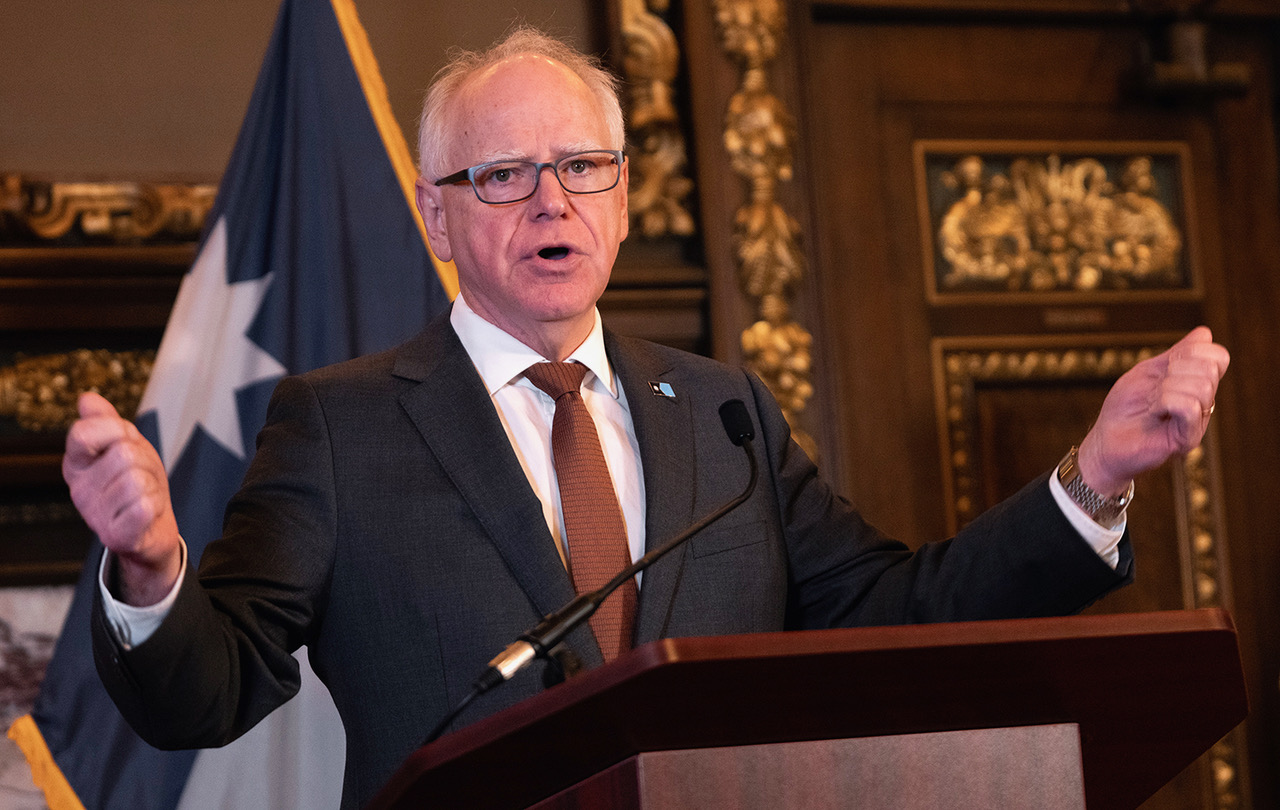
With 10 months left as governor, Tim Walz wants to pitch bold ideas whatever the political consequences.
How else to explain a news conference Tuesday in which Walz proposed to completely reorder the state’s Medicaid program that furnishes health care for disabled, elderly and low-income Minnesotans.
It is a plan that would add hundreds of state government jobs, while leading to untold job losses in counties and among nonprofit health insurers. The proposal would also shift the day-to-day lives of people enrolled in Medicaid and health care providers.
“I think without the major structural changes you’re going to find yourself chasing your tail on some of these things continuing forward,” said the governor, who proceeded to compare the health care program for around 20% of Minnesotans to “a bit of a Frankenstein’s monster that you keep putting bolts onto the side of.”
But the Legislature may ignore Walz here.
“This proposal as described by the governor has no future as far as I can tell in the Minnesota state Legislature,” said Paul Torkelson, R-Hanska, and co-chair of the House Ways and Means Committee.
As of Tuesday afternoon, no DFL lawmaker had gone on record to defend the governor’s proposal.
In fact, Sen. John Hoffman, DFL-Champlin and chair of the Senate Human Services Committee, stated that he was “disappointed to learn about this proposal just last night without a thorough conversation with the committee that has primary jurisdiction over Minnesota’s human services system.”
A rundown of the governor’s proposal and how it fits into Medicaid fraud.
What does Walz want?
Walz seeks to erase the nonprofit insurers known as managed care organizations that have ruled Minnesota Medicaid since the 1980s.
Currently, 80% of the state’s Medicaid enrollees find health care providers via several different managed care organizations like Blue Plus and Hennepin Health. Doctors and clinics bill these managed core groups, and these groups, in turn, get payments from the Minnesota Department of Human Services.
Under the governor’s plan, the Department of Human Services would directly reimburse providers who care for Medicaid patients.
The governor repeatedly said that Minnesota should follow Connecticut, which got rid of its own version of managed care organizations in 2012.
Forty-two other states (including Minnesota) have some type of managed care groups, according to health policy research group KFF.
Moreover, the governor wants Minnesota’s 87 counties out of the business of determining who is eligible for Medicaid. DHS would take on that roll as well.
Minnesota is just one of 10 states that lets counties run eligibility.
Counties have repeatedly lamented their burden in administering Medicaid. But the lion’s share of their complaints concern outdated computer systems used to determine eligibility, not performing the task itself.
At the news conference, Walz repeatedly mentioned revamping Medicaid IT. But neither the governor nor the Legislature have a firm proposal on this subject.
Julie Ring, executive director for the Association of Minnesota Counties, emailed Tuesday that she needs to learn more before opining too much on Walz’s proposal.
Ring said she did support Walz calling to “dedicate funding for a study to provide future recommendations” on how to administer human services programs.
How is this a step to fighting fraud?
Thanks to fraud allegations, Medicaid went from a point of pride for Walz to (arguably) ending the governor’s career in state politics.
But the nexus between fraud and this proposal is unclear.
Rep. Kristin Robbins, R-Maple Grove, noted that managed core organizations have their own internal auditors and that there would appear to be less fraud among these insurers compared with providers directly reimbursed by DHS.
Is Robbins right? We don’t know. Unlike providers who directly work with DHS, the governor has yet to audit managed care groups for fraud.
The Minnesota Council of Health Plans, the advocacy group for the managed care organizations, exercised herculean restraint in a statement Tuesday afternoon, stating they “remained committed to constructively working with the governor, the Legislature, and state agencies.”
The Council of Health Plans did add, “Consolidating Medicaid administration into a single statewide entity would concentrate operational and financial risk to an unprecedented degree. Policymakers should carefully evaluate how such a shift may affect accountability, competition, innovation and long-term market stability.”
About the author
Matthew Blake covers state government for MinnPost.