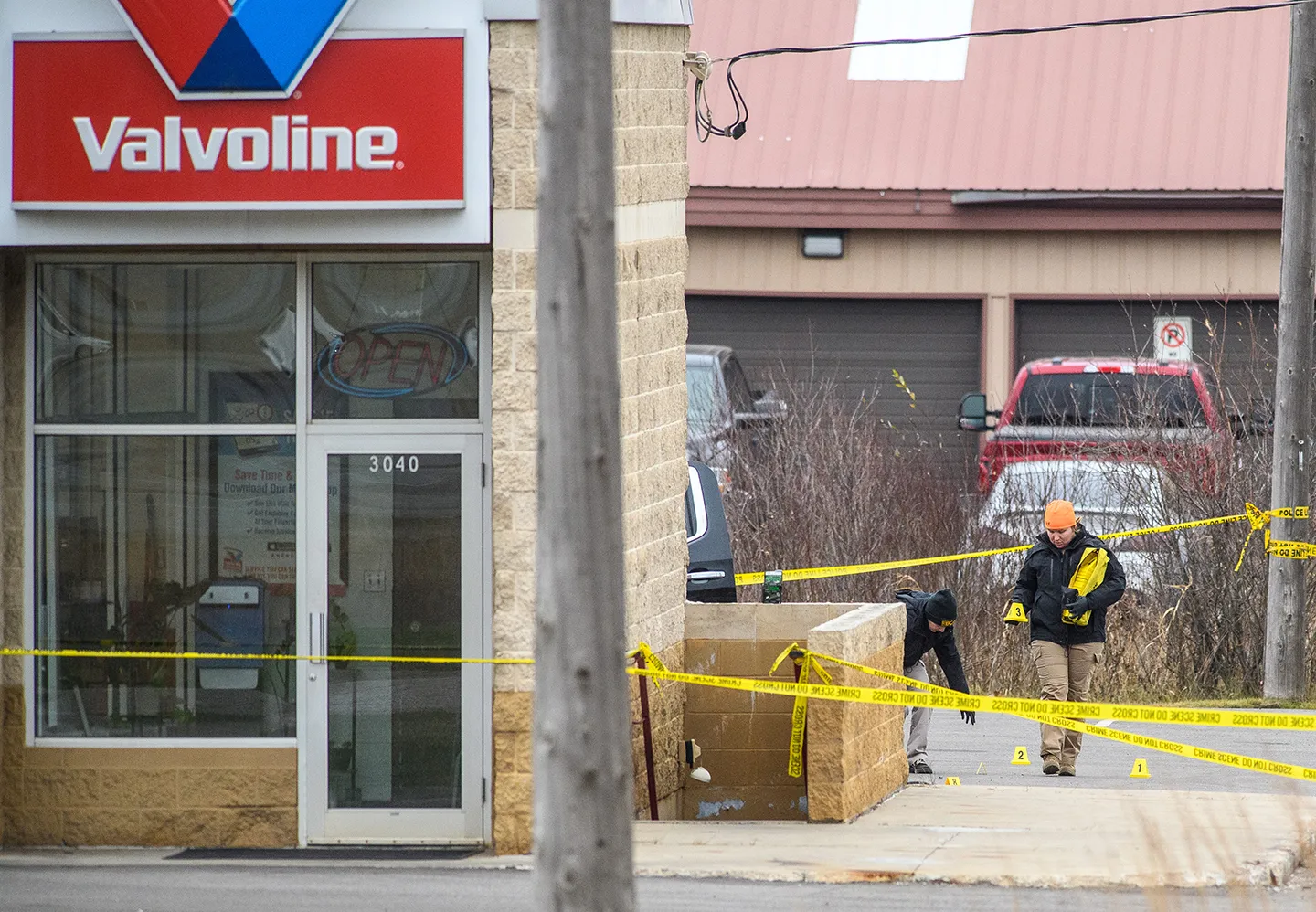
A forensic audit places the responsibility for nearly $4 million of misspent sales tax revenue on at least one Virginia city official.
The audit report from Perry Forensics, unveiled Tuesday with redactions to names and titles of those in city leadership, identified the shortfalls within the Virginia’s structure. It did not independently confirm details, such when the money was transferred, what it was spent on, who authorized the transfers.
Still, the firm’s breakdown of oversight included the city administrator, finance director, city council and attorney.
Virginia fired its finance director in September, replaced its attorney last month with another firm. A special meeting is scheduled Dec. 1 for a second closed door performance review of City Administrator Britt See-Benes.
There was little discussion on the audit report as the Perry Forensics team and city council appeared to have a miscommunication on the expectations for the special meeting.
The Ohio-based Perry Forensics team appeared virtually with no formal presentation and the city with few questions for them.
“Next meeting we have, we better have answers,” said Virginia resident John Pearsall, during a later public comment period.
Among the findings, beyond responsibility, was a lack of safeguards around the funds, no evidence of nefarious activities leading to the missing funds, and a 13-point corrective action plan — some of which Virginia started to put in place when the missing funds were noticed.
Councilor Julianne Paulsen said the city needed to move on the corrections as soon as possible, citing the potential impact on the 2027 budget process.
The city already set a maximum tax levy increase at 8%, but part of the plan set by state law and the forensics team included a plan to repay the $3.9 millions of misused funds.
“That’s going to be key in moving forward,” Paulsen said. “I don’t care how long it takes … each one of these needs to be addressed.”
Tuesday’s meeting underscored the frustration residents have had with the city’s financial status and operation.
Councilors often sat in silence as technology issues limited how well Perry Forensics could hear the meeting through the virtual meeting. When asked for a high-level overview, the forensics team had little to say.
Parts of the report were read verbatim by the council, which also seemed discombobulated by the lack of a form report from Perry Forensics, though it was unclear what city officials expressed as needs for the meeting.
Mayor Larry Cuffe Jr. called the meeting “embarrassing” but said Perry Forensics did a “very comprehensive investigation.”
Councilor Justin Skalko called it a “disaster” and expressed regret taking time off work for the meeting.
When Virginia established the forensic audit timeline, it accounted for a presentation on how the audit firm reached its conclusion. But it was unclear where the breakdown occurred.
“I spent two hours here reading it,” said Annie Bachschneider, a current councilor and mayor-elect. “Every person deserves to have the opportunity to see the results and hear from our forensic auditors and they got to this result.”
Another meeting with an audit presentation was approved, but no date set.
Perry Forensics also raised the potential for nonfeasance of duty, both in the management of restricted sales tax revenue and the financial planning that preceded construction of the event center.
The firm noted a city official’s failure to perform a required duty or appropriately address known financial irregularities could constitute nonfeasance, though it left a determination to legal counsel.
“The money was spent sometimes appropriately, sometimes not in compliance with the law that was established by the 1% sales tax by the state Legislature,” Cuffe said. “We have taken necessary steps to ensure that we comply with the law.”
What the forensic audit found
Virginia collected more than $15 million through its voter-approved 1% local sales tax between January 2020 and June 2026, of which $10.1 million was spent on principal and interest payments on bonds issued to construct the Iron Trail Motors Event Center.
Another $641,037 was identified as capital expenditures associated with the event center, leaving the city with an expected balance of $4.27 million.
Instead, the city had approximately $287,633 reflected in the associated fund balances, with the remaining $3.98 million listed in financial records as an amount owed by the event center.
Perry Forensics was unable to independently establish the transactions that made up the nearly $4 million balance, including when the money was transferred, what it was spent on, who authorized the transfers and whether any repayment terms were established.
The firm also estimated the city could have generated another $611,595 in interest had the sales tax revenue been invested, bringing the projected balance to nearly $4.9 million.
“The money gone is greater than $3.7 million,” said Councilor Liz Motley. “It’s 4.3 million if you include interest, which you can’t because it was never invested. It was spent without our permission.”
At the center of the financial discrepancies was Virginia’s practice of pooling its cash, in which money from multiple city funds was held in the same bank and investment accounts. Individual fund balances were tracked through the city’s accounting system rather than separate accounts.
While the practice is not uncommon among municipalities, Perry Forensics noted it does not absolve the city of its responsibility to safeguard funds that are legally restricted.
The investigation found Virginia lacked sufficient safeguards, written policies, documentation of fund transfers and reconciliation practices to adequately track the sales tax revenue.
“While the review does not conclude intentional misconduct occurred, the absence of documented financial sustainability analysis raises questions regarding the adequacy of project planning, due diligence, and oversight,” the Perry Forensics report read. “It also increases the risk future operating obligations and financial exposure will not be fully understood or considered during the decision-making process.”
Questions surrounding the permitted use of the sales tax revenue dated back to at least 2021, when correspondence between city officials showed differing interpretations of how money collected beyond the city’s annual bond payments could be spent.
The city’s municipal financial advisor, following consultation with bond counsel, clarified at the time that excess revenue could accumulate for future bond payments or be spent on certain facility-related repairs, maintenance and capital improvements.
The legislation authorizing Virginia’s sales tax did not provide for the money to be spent on routine operations of the event center or to supplement the city’s general cash flow.
Yet a financial flowchart included in the forensic report identified the remaining sales tax revenue as having been commingled with the city’s general operating funds and subsequently applied toward operating costs at the event center, which Perry Forensics characterized in the chart as a violation of Minnesota sales tax law.
Elsewhere in the report, the firm stopped short of concluding the money was knowingly spent on unauthorized purposes, citing a lack of documentation to establish the individual transactions.
An event center operating at a loss
While the management of sales tax revenue was the primary focus of the forensic audit, the investigation also raised questions about the financial planning that went into constructing the event center and its continued operation.
Perry Forensics was unable to locate or obtain any feasibility studies, business plans, revenue projections, operating cost estimates or presentations to the city council demonstrating the long-term financial sustainability of the facility.
The nearly $39 million facility opened in September 2021 and has since generated approximately $8.9 million in cumulative operating losses, when excluding capital improvements and accounting for nearly $4.9 million in financial support from other city funds.
Even with annual transfers of approximately $1 million from other city funds between 2022 and 2025, the event center continued to operate at a deficit.
The facility’s largest annual deficit after transfers came in 2022, when it lost $1.5 million. That year, expenditures exceeded the city’s budget by nearly $1.25 million, including approximately $516,600 in unbudgeted salary costs above the approved amount.
Revenue projections also routinely exceeded what the facility was able to generate.
Virginia anticipated nearly $1.5 million in event center revenue in 2023, despite the facility generating just $637,262 the previous year. Actual revenue fell short of the city’s projections by approximately $700,000, including nearly $375,000 in anticipated ballroom rental revenue.
The city subsequently scaled back its revenue projections, but the event center’s annual revenue remained relatively stagnant at approximately $800,000 between 2023 and 2025.
In 2025, the facility generated $803,722 in revenue against nearly $2.38 million in expenditures.
Perry Forensics acknowledged the event center’s recreational, tourism and economic development benefits were not necessarily reflected in its operating revenue, but noted the benefits came with a significant and ongoing financial commitment from the city.
“I think you have perfected and built a fantastic event center from all I can hear and read about,” said Larry Mincks of the Perry Forensics. “You certainly have to be the envy of the entire area.”
Years of financial warnings
Many of the financial management shortcomings identified by Perry Forensics were not new to Virginia.
As part of its investigation, the firm reviewed six years of management letters issued by the city’s external auditor, Walker, Giroux & Hahne, which identified recurring issues with budgeting, financial reporting, deficit fund balances, interfund liabilities and accounting practices.
Virginia’s 2024 audit upgraded the deficiencies as a “material weakness” where there exists a real risk that a significant financial error could go undetected. See-Benes said the city’s finances became more complex and staff turnover contributed.
The number of city funds operating with deficit fund balances grew from three in 2020 to 12 in 2023, before declining to six in 2024 and increasing again to nine in 2025.
The number of funds owing money to other city funds because of negative cash balances also increased from nine in 2024 to 12 in 2025.
Virginia’s unassigned general fund deficit more than doubled during that same period, growing from approximately $700,000 at the end of 2024 to nearly $1.6 million at the end of 2025.
General fund expenditures exceeded the city’s budget by approximately $1.6 million in 2025 alone.
Perry Forensics noted the recurrence of similar findings in the city’s annual audits indicated corrective measures were either not fully implemented, were ineffective or were not sustained.
Despite the recurring financial management issues, the city’s external auditor told councilors in June that its audits had not identified issues with the handling of sales tax revenue or associated expenditures.
At the same meeting, city officials acknowledged that approximately $3.7 million in cash and investments was not available to be transferred into a restricted investment account.
Restoring the money
Among the corrective actions recommended by Perry Forensics was a transaction-by-transaction reconstruction of the nearly $4 million owed by the event center, including identifying the origin, purpose and authorization of each transaction.
The firm also recommended Virginia determine how much restricted sales tax revenue is currently available and establish a formal plan to restore the money that is not.
Other recommendations included monthly reconciliations of sales tax revenue, formal authorization and documentation of fund transfers, written policies governing restricted revenue and more detailed financial reporting to the city council.
Perry Forensics also recommended the city develop a multiyear financial sustainability plan for the event center that accounts for anticipated operating revenue, expenditures, capital improvements and the financial support needed from other city resources.
The report did not establish how Virginia would fund the repayment of the sales tax revenue or whether the nearly $4 million owed by the event center is fully recoverable.